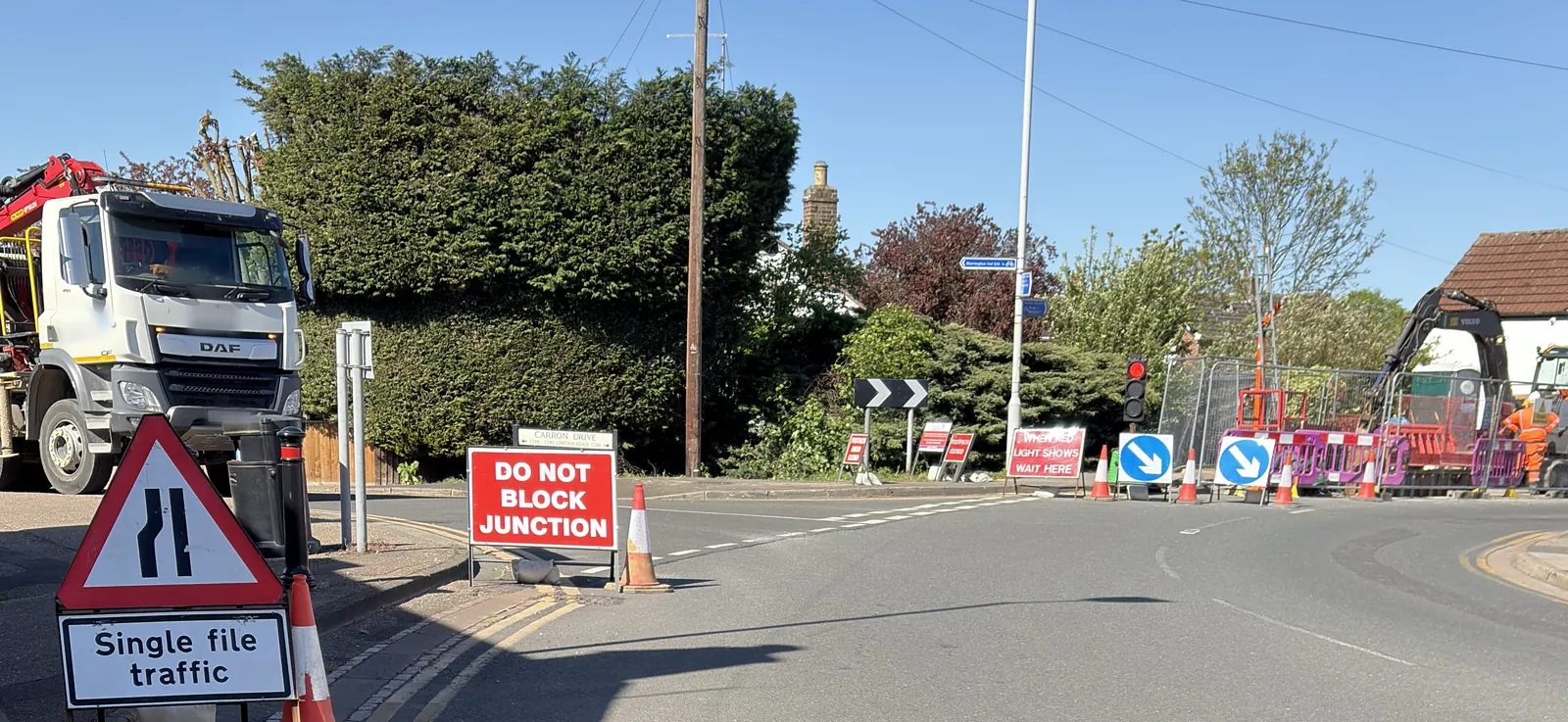
Not blocking a junction means leaving room for other vehicles to turn into and out of it when traffic is queuing, whether or not a sign is there to remind you. The Highway Code treats this as advice in slow-moving traffic (rule 151) and as law at a box junction (rule 174). This guide explains the difference, why roadworks and temporary traffic lights are a common place to get it wrong, and what DVSA's published marking guidance says that is relevant to your driving test.
Keeping Junctions Clear in Queuing Traffic
The Highway Code's advice for slow-moving traffic is rule 151. It says you should reduce the distance between you and the vehicle ahead to maintain traffic flow, and never get so close that you cannot stop safely. It also says you should "allow access into and from side roads, as blocking these will add to congestion".
Advice, not a MUST: Rule 151 is worded as advice ("you should"). The Highway Code explains that rules marked MUST or MUST NOT are legal requirements, and that failing to follow the other rules will not, in itself, cause someone to be prosecuted. It also says the Code may be used in evidence in court proceedings under the Traffic Acts, including rules that use advisory wording such as "should". So treat it as advice to follow, not something to ignore.
Rule 151 does not depend on a sign or a road marking being there. It applies whenever you are in slow-moving traffic and there is a side road or junction mouth beside you. Sometimes the right place to stop is much further back than you would think, or than you would choose on your first attempt.
Where a learner is on their journey makes a big difference here. Early on, many feel a lot of pressure from the vehicle behind, even when the driver behind is doing nothing at all. That pressure, perceived or real, is often what causes a stall, especially the first few times they meet heavier traffic at junctions. In their hurry to move off and not hold anyone up, they release the clutch too quickly and the car stalls. With experience the fear of the car behind fades, and they start to focus on what they need to do and what they are doing.
The other mistake I see all the time is stopping too close to the vehicle in front. The phrase I use with my pupils is "tyres and tarmac": when you stop, you should be able to see the rear tyres of the vehicle ahead and a strip of tarmac beneath them. It fits with Highway Code rule 151, which says to leave enough space to manoeuvre if the vehicle in front breaks down. That gap matters for other reasons too:
- The vehicle in front may roll back. If you are too close, you have very little time to react or sound your horn.
- Learners stall. A stalled car can jump forward, and with no gap it can hit the car in front.
- Emergency vehicles need room. If one approaches from behind, you need space to move safely out of its way.
- Gaps limit the damage in a shunt. If every car in a queue is too close and one is hit from behind, the impact can pass down the line like dominoes. With more space, it may only reach the first two or three cars, depending on the speed and the size of the gaps.
I have seen four cars hit in a row. That wasn't in stationary traffic but on the move, because drivers weren't leaving a safe following distance. In my experience, collisions involving several vehicles because of following distance are, sadly, very common.
Leaving a gap and keeping a junction clear are two different skills. The gap is about the car in front of you. Keeping the junction clear is about where you decide to stop in the first place.
Before you stop in a queue near a junction, ask yourself:
- Will there be room for my car beyond the junction?
- Am I leaving space for vehicles to turn in or out?
- If the traffic stops now, where will I end up?
If the junction has yellow criss-cross box markings, the position changes from advice to law, which is covered in the next section.
Box Junctions: Where Keeping Clear Becomes Law
A box junction has criss-cross yellow lines painted on the road. Rule 174 is worded as a legal requirement: "You MUST NOT enter the box until your exit road or lane is clear."
The rule makes one exception, for turning right. You may enter the box and wait if you want to turn right and are only stopped from doing so by oncoming traffic, or by other vehicles waiting to turn right. It also says that at signalled roundabouts you MUST NOT enter the box unless you can cross over it completely without stopping.
Away from a box, nothing is painted on the road to show where to stop short, so rule 151 from the queuing traffic section is the one to follow. For how priority works at different junction types, see our guide to junction priority rules.
Roadworks and Temporary Traffic Lights
- Obey the temporary lights and wait where the sign tells you to.
- Even on green, make sure there is room for your car beyond the junction and through the works before you go.
- If you can't get through, wait for the next green.
Roadworks are a common place for queues to build across a junction, because traffic is held at a temporary red light with the junction right beside the queue.
For road works in general, rule 288 tells you to take extra care when the "Road Works Ahead" sign is displayed, to look for additional signs providing more specific instructions, and to observe all signs. It also says to watch out for vehicles entering or leaving the works area, and not to switch lanes to overtake queuing traffic.
Where to stop at temporary lights
Rule 176 says you MUST NOT move forward over the white line when the red light is showing. Temporary lights do not normally have a white line, and rule 176 does not mention temporary signals. The Department for Transport's Know your traffic signs guidance covers this. It says portable traffic signals "operate in the same way as permanent traffic signals", that "Normally, a stop line is not marked on the road", and that "A sign is used instead to indicate where you must stop when the red signal shows."
The board in the photo at the top of this page, reading "When red light shows wait here", is diagram 7011 in the Traffic Signs Regulations and General Directions 2016 (Schedule 14, Part 2, item 58). The regulations describe it as the "Point beyond which vehicular traffic must not proceed when required to stop" at portable light signals, where a stop line is not placed on the carriageway. So when the light is red, you wait at the board.
Moving off on green
Rule 176 also says to go forward on a green light only if there is room for you to clear the junction safely, or if you are taking up a position to turn right. That wording is advice, not a MUST NOT, and it sits under the Code's heading for junctions controlled by traffic lights rather than temporary signals. The sense still carries over: do not move off on green into a space that will not clear the junction.
The "Do not block junction" board
The red board in the photo at the top of this page reads "Do not block junction". The Highway Code's road works rules (288 to 307) do not describe a board like this, so this page does not treat it as a rule in its own right. Rule 151 applies with or without it.
What This Can Mean on Your Driving Test
DVSA publishes the standards examiners mark against in its examiner guidance, Carrying out driving tests, Annex 6: Guide to assessment and marking, and a plainer candidate version, Understanding your driving test result. DVSA's published guidance doesn't name junction blocking as a specific fault, so this page doesn't give it a fault category. How it is marked depends on what happened and the examiner's judgement, as in the example from one of my pupils' tests below.
What DVSA does publish are the three types of fault, which apply to anything you do on the test. A dangerous fault "involves actual danger to you, the examiner, the public or property", a serious fault is "something potentially dangerous", and a driving fault is "not potentially dangerous, but if you keep making the same fault, it could become a serious fault". To pass you can have no more than 15 driving faults and no serious or dangerous faults. Our guide to driving test faults explains how these work in practice.
The closest published examples of how DVSA treats obstructing another vehicle are these:
- Turning right: the examiner guidance says "other vehicles should not have to stop, slow down or swerve to allow the vehicle to complete its turn". This describes your own right turn, but it shows the standard.
- Stopping: the examiner guidance lists "Stopped, partially blocking a driveway with no inconvenience to other road users" as a driving fault example, and "Stopped, completely blocking a driveway inconveniencing vehicle attempting to pull out" as a serious fault example.
- Common faults: the candidate page lists "obstructing other road users" among the common faults for the area covering where you stop.
These examples are about stopping and parking, and about your own turns. They are not a ruling on queuing at a junction, so read them as a guide to the standard rather than a fault list for this situation.
I make sure my pupils experience this during lessons, well before test day. Sometimes they will block a junction or a driveway, and then the penny drops: they should have waited further back instead of carrying on. It all comes down to good planning. What can they see ahead, and what will they do about it? Meeting traffic is where this comes up most often: driveways, junctions, vehicles parked almost opposite each other, and large vehicles like buses trying to fit through a gap.
I have seen it marked on test. A pupil of mine met an oncoming car with a parked car on our side of the road, and squeezed through the gap instead of waiting. The examiner marked it as one driving fault, because my pupil should have held back and let the oncoming car through.
In lessons I ask questions like "Was that the safest option?", "How safe was that?" or "Could you have made that safer?" As test day gets closer and a pupil is clearly focused on it, I remind them: "All the examiner wants to see is a confident and safe drive."
For what the rest of the day involves, see what happens on driving test day.
Sources
- The Highway Code: Introduction, Wording of The Highway Code
- The Highway Code: General rules, techniques and advice (rules 103 to 158), rule 151
- The Highway Code: Using the road (rules 159 to 203), rules 174 and 176
- The Highway Code: Road works, level crossings and tramways (rules 288 to 307), rule 288
- Department for Transport: Know your traffic signs, signs for road works and temporary situations
- Legislation: The Traffic Signs Regulations and General Directions 2016, Schedule 14, Part 2, diagram 7011
- DVSA: Carrying out driving tests, Annex 6: Guide to assessment and marking
- DVSA: Understanding your driving test result, car driving test
- GOV.UK: Driving test faults and your result
You Might Also Find Useful
Please note: This is general driving guidance, not a substitute for in-car instruction. Always follow the actual lanes, road markings, signs, and signals in front of you, they take priority over anything written on this page.
Keep Building Your Driving Knowledge
Explore our free guides to build your knowledge before your first lesson.
View All Driving Guides