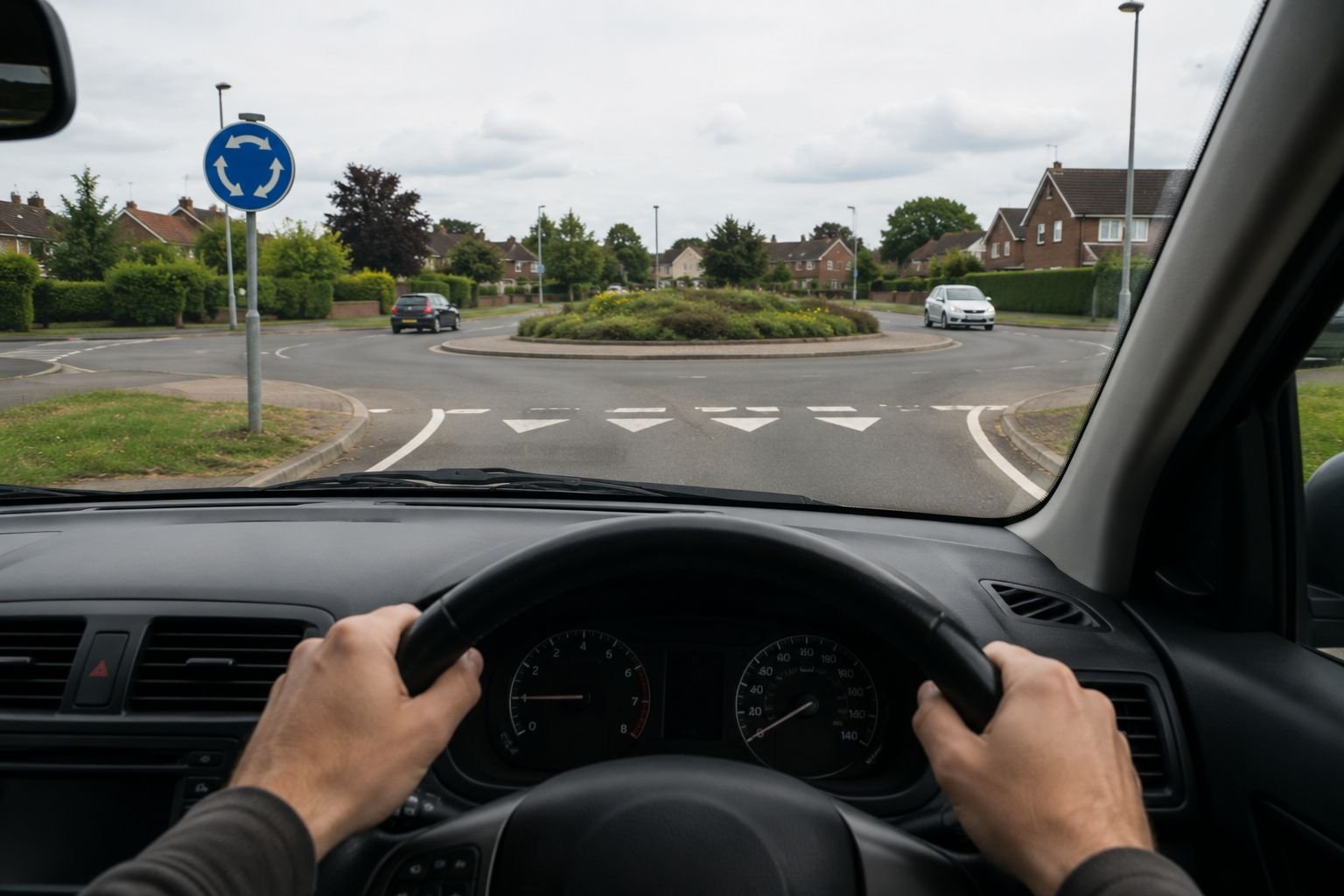
For many learners, roundabouts cause more hesitation and more test faults than almost anything else on the driving test route. This guide covers standard roundabouts without traffic lights, which is what most junctions of this kind actually are; roundabouts controlled by traffic lights are covered in a separate guide. The good news is that a roundabout is not something you need to feel intuitively; it is a sequence you can learn, practise, and eventually do without thinking about it. This guide breaks down exactly what your instructor is watching for on approach: the priority rule, the MSM routine, lane choice, signalling, and observation.
What a Roundabout Actually Asks of You
Every roundabout in the UK works from the same starting rule: give way to traffic already on the roundabout, approaching from your right, unless road signs, markings or traffic lights tell you otherwise. That single rule is what everything else on this page hangs off. Once you can judge that reliably, lane choice and signalling become much easier, because you are no longer trying to do everything at once.
The MSM Routine at a Roundabout
Mirror, Signal, Manoeuvre applies at every stage of a roundabout, not just once on approach. In practice that means:
- Mirror check as soon as you see the roundabout sign or markings, to know what is behind and beside you before you start slowing down
- Signal, where needed (see below), once you have decided which exit you need and chosen your lane
- Manoeuvre: position, speed, and observation working together as you enter, cross, and leave
The habit worth building early is deciding your exit as early as possible, ideally from the advance direction signs, rather than working it out at the give-way line under pressure.
Choosing the Right Lane on Approach
Most roundabouts give you the lane information you need before you arrive, through road markings and signs. Left arrow, straight-ahead arrow, right arrow, or a combination, tell you which lane to be in well before the give-way line. Read these early and settle into the correct lane in good time rather than changing lanes at the last moment.
Where markings are unclear or missing, the general guidance is: left lane for the first exit, right lane for a right turn or full circle, and either lane for a straight-ahead exit, bearing in mind you may need to change lanes on the roundabout itself if you end up in the wrong one. If a learner does end up in the wrong lane, the safest option is almost always to stay in that lane, signal correctly for whichever exit it leads to, and go round again if needed, rather than trying to cut across at the last second.
Signalling Correctly
This is where I see the most consistent test faults. The rule of thumb:
- First exit, left: signal left on approach and keep signalling left all the way round to that exit
- Straight ahead, or any exit that is not first or last: normally no signal needed on approach; stay in your chosen lane, then signal left once you have passed the exit before the one you want
- Right exit, or full circle: signal right on approach, hold that lane, then cancel the right signal and signal left once you have passed the exit before the one you want
The most common mistake is signalling left far too early, which then confuses drivers waiting to join the roundabout, who assume you are about to exit.
Observation: Timing Your Move
Judging a safe gap is a skill that only comes with repetition, but the elements are consistent: watch the speed and position of approaching traffic, not just whether the road looks clear, and be ready for drivers who are indicating incorrectly or not at all. Two failure modes to watch for in equal measure: pulling out into a gap that is not really there, and sitting at the give-way line so long that it becomes hesitant, unsafe stopping.
Common Mistakes Learners Make
The faults I see most often, roughly in order:
- Hesitating at a clear gap, then moving off too late once traffic has caught up
- Creeping forward without ever fully committing, unsettling drivers behind
- Checking mirrors too late, after already starting to signal or move
- Signalling left far too early or too late for the intended exit
- Losing lane position mid-roundabout, drifting wide or cutting the exit
Building Confidence Through Practice
Most instructors start learners on a quiet, single-lane roundabout, where there is time to think through each stage without pressure. As confidence builds, moving to busier or larger roundabouts, and eventually multi-lane ones, lets a learner apply the same routine at higher traffic volumes and speed. Talking a learner through each stage out loud in early lessons, then gradually stepping back, is usually how independence develops.
Frequently Asked Questions
Do I always have to give way at a roundabout?
Give way to traffic already on the roundabout approaching from your right, unless signs, road markings or traffic lights tell you otherwise, in which case follow what they say instead.
What if there are no lane markings?
Use the general rule: left lane for the first exit, right lane for a right turn or full circle, and either lane for straight ahead. If you end up in the wrong lane, stay in it, signal correctly, and go round again if needed.
What is the correct signal for going straight ahead?
For most straight-ahead exits, no signal is needed on approach. Signal left only once you have passed the exit before the one you want.
How do I know which exit I am counting?
Count from the road you are approaching on, not from twelve o'clock. The exit you came in on does not count as one of the exits you are counting past.
What if I take the wrong exit?
Stay calm, indicate as normal for the exit you are now taking, and if it puts you off route, use a safe turning point or sat nav to get back on track. It is not a serious fault in itself unless it is done unsafely.
Related Roundabout Guides
Please note: This is general driving guidance, not a substitute for in-car instruction. The real situation in front of you, and what your instructor tells you, always takes priority over anything written on this page.
Keep Building Your Driving Knowledge
Whether you've decided on manual or automatic, explore our free guides to build your knowledge before your first lesson.
View All Driving Guides